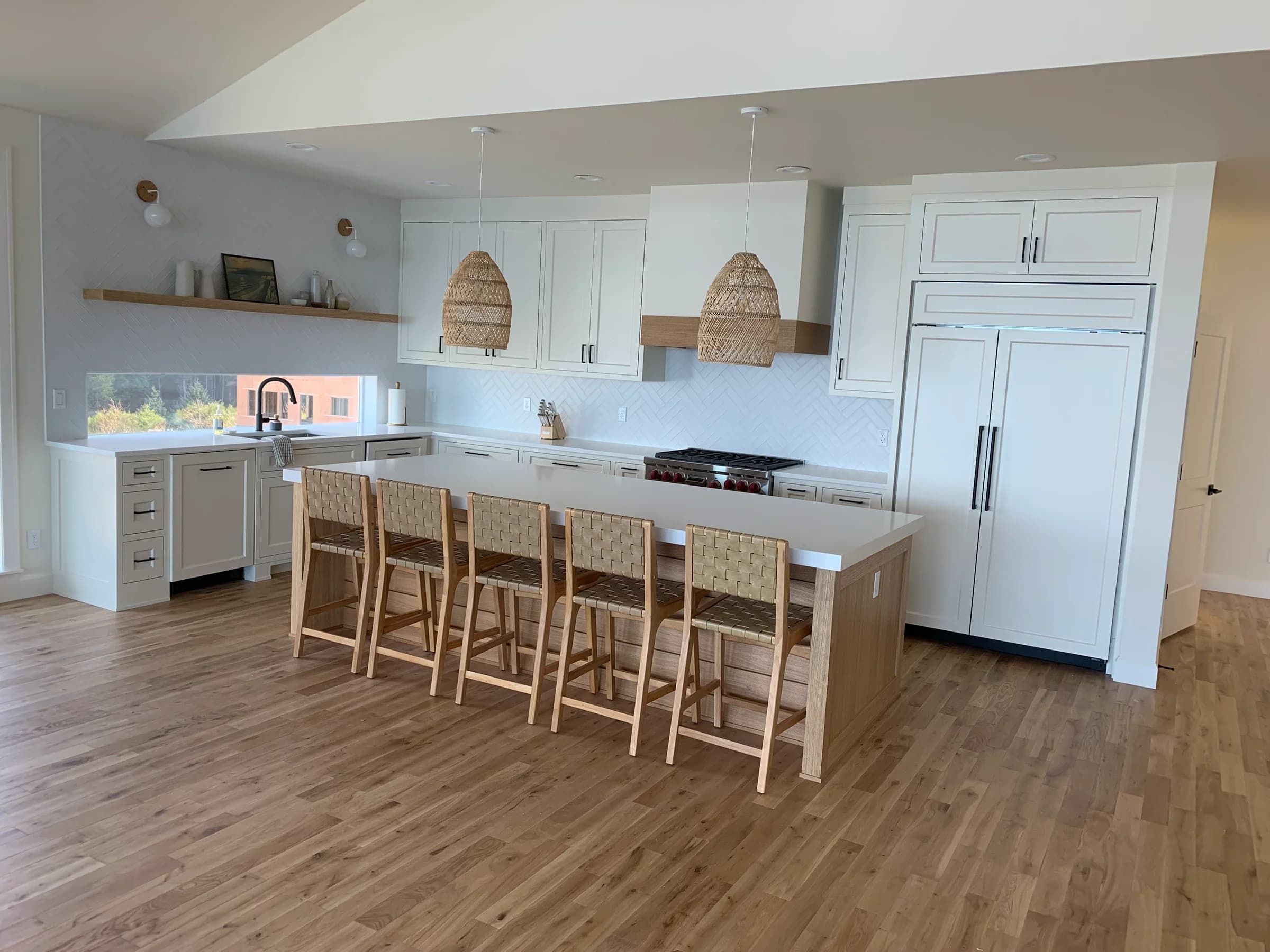
What does “refinishing” mean for your cabinets?
People use refinishing to describe everything from a fresh coat in the same color to taking wood back to a bare surface. The word alone does not define a project. The useful question is what you want to see when the work is finished: a solid painted color, refreshed visible wood, a different stain tone or a corrected finish after a previous failure.
We offer cabinet painting, staining, wood finishing and stripping to bare wood where appropriate. The choice depends on the cabinet material, existing finish and target appearance. You can start without choosing the technical route. Tell us what bothers you and show us the cabinets; the first job is to connect that goal with a suitable scope.
Read the wear before choosing the remedy.
Photograph the areas that are least flattering. A worn edge at the sink, cloudy clear coat, chips around a handle and paint lifting in sheets provide more useful clues than a distant photograph of the whole room. Also show areas that still look good. The difference helps establish whether the issue is isolated or spread across the kitchen.
Some problems are mainly in the finish; others involve the material below it. Soft, swollen or separating components need assessment before cosmetic work. If a leak or recurring splash is involved, resolve the cause before asking a new finish to cover the evidence. Finishing can change a surface, but it cannot make ongoing moisture or a weak cabinet structure disappear.
| What you see | What to establish first |
|---|---|
| Worn color near handles | Localized wear or wider finish breakdown |
| Peeling or flaking paint | Which layer is failing and what is sound beneath it |
| Swelling or separating edges | Condition of the cabinet material and moisture source |
| A finish you no longer like | Paint, visible wood, texture and color goals |
When an earlier paint job needs another chance.
If the cabinets were painted before, share whatever you know: when the work happened, whether it was DIY or professional, which products were used and when the problem first appeared. An old invoice or leftover product label can be useful. If you have none of that information, close-up photos are still the right place to begin.
A failing layer needs a plan of its own. Putting a new finish over material that is releasing does not address the weak connection below. The extent of removal, surface preparation and repair can change the project considerably. We can assess failed paint jobs, including whether stripping is appropriate, without promising that every door will be economical to save.
Choose a destination: painted, wood-toned or back to wood.
Paint gives you an opaque color while retaining the door's profile and, depending on preparation, some of its texture. A wood refresh keeps visible grain and works within the appearance of the existing wood. A different stain can involve a more substantial change to the current finish, especially when you want to go lighter.
Taking painted cabinets back to wood is a separate assessment. Paint can conceal mixed materials, repairs or veneers that were never intended to look identical when exposed. A door that looks like wood from the front may have a different core or edge. The goal is to establish what can actually be revealed before selecting an inspiration photograph as the promised result.
Refinishing, refacing and replacement answer different questions.
Refinishing changes the finish on the cabinetry you keep. Refacing changes the visible fronts or exterior covering while retaining suitable boxes. Replacement changes the cabinets themselves and may be part of a new layout. A sound kitchen with a color problem is a different starting point from one with broken storage or a layout that does not work.
You do not have to decide based on the biggest advertised transformation. List your frustrations and separate them into appearance, function and condition. If the function is good and the structure is sound, refinishing deserves a close look. If you need different storage or substantial structural correction, compare the broader options before committing to finish work.
How the work is divided between shop and home.
For a cabinet painting project, doors and drawer fronts are removed and sprayed in the shop. The installed boxes are sprayed on-site with full masking and containment. A staining or stripping project may require a different preparation sequence, so the written scope should describe the route selected for your cabinetry.
Typical kitchen finishing work takes about a week, but extensive failed-coating removal, repairs or a complex stain change can alter the schedule. Ask which parts leave the home, what stays in place and when access is limited. Also confirm the handling and cure guidance for the actual finish. “Work completed” and “ready for unrestricted use” are not automatically the same date.
Make the proposal easy to compare.
A useful proposal identifies the surfaces, condition issues, preparation, finish direction and any repairs. It should make the status of interiors, exposed ends, crown, glass-front sections and adjacent built-ins clear. If the island receives a different color or oak grain filling is requested, those decisions should be visible in the scope.
Be cautious about comparing only a total and the word “refinish.” One proposal might preserve the existing surface with limited preparation, while another includes removal of a failed coating. Ask what happens if the assessment finds an unstable area or a component that should be replaced. Clear answers before work begins are more valuable than a broad promise that every cabinet can be saved.
Show us the problem you want solved.
Start with a full view of the cabinetry, one close-up of the finish and detailed photos of the damage. Tell us whether you want to keep visible wood or change to paint. Include your city, approximate timing and any previous work you know about. There is no need to make the room look perfect first.
With 20+ years in cabinet and fine wood finishing, NS Wood Finishing can help turn those observations into a focused project discussion. Request a quote request or call 360-903-6298. The next step is to understand your cabinets well enough to recommend work that fits their condition and the way you want the room to feel.
LET’S LOOK AT YOUR PROJECT
Bring the question back
to your own cabinets.
A wide view, a close-up, and any areas of concern are enough to start a useful conversation.
Get my quoteYour questions, answered.
01Can you refinish cabinets that have already been painted?+
Yes, previously painted cabinets can be assessed. The current coating must be evaluated, especially if it is peeling, soft or heavily textured. The amount of removal and preparation depends on what is still sound.
02Does refinishing always mean stripping to bare wood?+
No. It describes several possible scopes. Some projects keep a sound existing finish as part of the preparation; others need more extensive removal. The required process follows the condition and desired result.
03Can refinishing fix water-damaged cabinets?+
Finish wear and damaged cabinet material are different issues. Share close-ups and explain whether the moisture source has been corrected. Swollen or separating components may need repair or replacement before finishing is sensible.
04Can a small damaged area be repaired without a full refinish?+
Possibly. Location, extent of damage, color and sheen all affect whether a localized repair will blend acceptably. Our cabinet repair and touch-up service is a useful starting point when the rest of the finish is in good condition.
Sources & further reading
Research reviewed October 2026. Population and housing data describe the source sample, not an individual home or its cabinetry. Manufacturer references are educational and do not identify the system used by NS.