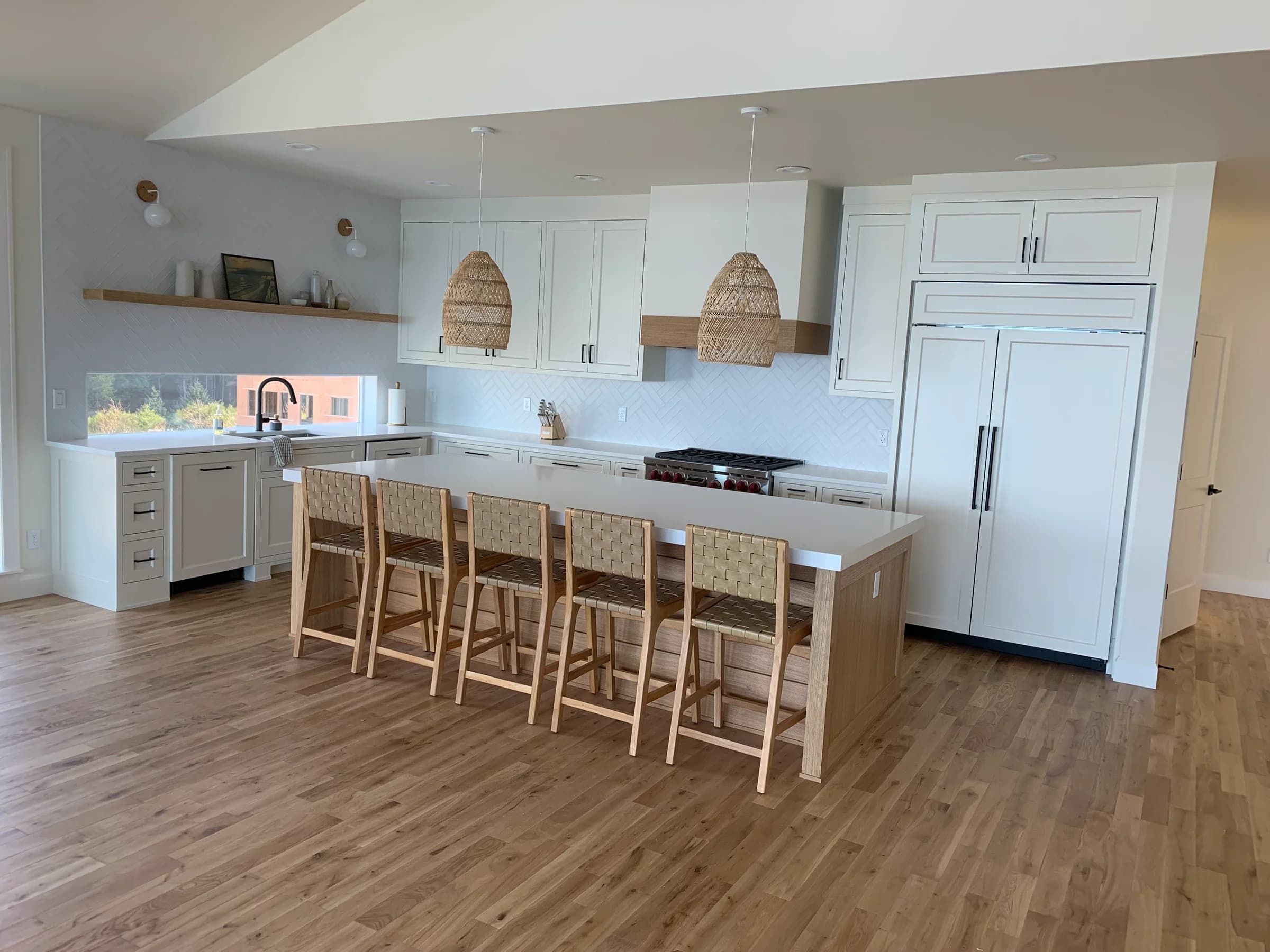
Three ways to rethink an oak kitchen.
Start with what you want to see when you walk into the room. If the color is the problem but you like the wood texture, painted oak with visible grain may suit you. If you want a quieter, smoother painted surface, grain filling is a separate preparation choice. If wood belongs in the room, explore a restain or finish change instead of assuming paint is the only update.
None of these directions is automatically right for every kitchen. The existing finish, wood condition and desired color shift influence the work. A photograph taken at an angle is especially helpful for oak because it shows the texture. Say explicitly whether you want to keep that texture, soften its appearance or preserve the wood itself.
| Finish direction | What you keep | What to establish first |
|---|---|---|
| Paint with visible grain | The texture of the oak | Color, sheen direction and existing finish condition |
| Paint with grain filling | The existing doors and layout | How smooth you expect the surface to look |
| Restain or refinish the wood | Visible wood character | Feasibility of the desired tone on the actual material |
Refinish, reface or replace: compare the right scope.
Refinishing changes the existing cabinet finish. Refacing typically changes visible doors or surfaces while retaining the boxes. Replacement changes the cabinetry itself and can become part of a wider layout renovation. If the problem is a dated color, those choices solve different amounts of the problem. If the problem is poor storage, damaged boxes or an awkward arrangement, a finish alone may not solve enough.
Ask each estimate to identify what stays and what changes. Include effects on counters, backsplash, hardware and surrounding trim. You need a comparison of complete work, not a cabinet-painting figure beside a replacement figure that omits installation or related work. Our cost guide helps organize those questions without assigning your kitchen a price from its neighborhood.
The 1990s and early 2000s shaped much of Battle Ground.
In the October 2026 Clark County assessor analysis, 51% of built parcels inside Battle Ground dated from 1990 through 2009. That gives the city a substantial group of homes at an age when owners may be reconsidering original kitchen finishes. It does not tell us how many kitchens still have their first cabinets, or which wood was used.
The house types differed between those decades. In a separate city parcel dataset, 62% of the recorded 1990s conventional homes were ranches, while 63% of the 2000s group were two-story houses. That is useful local context, but the size of a home is not a cabinet count. We work from photos and the actual pieces in your room.
Find the part of Battle Ground that resembles your house.
Recorded subdivision groups show several distinct eras. Clover Meadows, Hidden Meadows, Golden Hills and neighboring late-1990s plats formed one research group with a 1999 median build year. Parkview Trails, Crestwood Meadows and nearby early-2000s plats formed another with a 2003 median. The older additions around the center of town have an earlier story.
Use the table as background for your request. If your kitchen was replaced in a later remodel, tell us that date too. It is common for the questions that matter most to be very specific: whether a sink cabinet is sound, whether an island matches the other doors, or whether an earlier paint layer is peeling.
| Research group | Median recorded build year | First thing to photograph |
|---|---|---|
| Original town and pre-1960 additions | 1959 | Cabinet details and original built-ins |
| 1966–1974 ranch-addition group | 1975 | Existing finishes and any damaged areas |
| Late-1990s subdivision group | 1999 | Door face, wood grain and worn edges |
| Parkview Trails and early-2000s neighbors | 2003 | Kitchen overview, doors and any island |
| South and central infill group | 2008 | All materials included in the update |
| Recent 2017–2026 plat group | 2022 | Door edges and manufacturer details if known |
A smaller room still deserves a complete estimate.
A single-level kitchen may have fewer cabinets than a larger two-story home, but that is something to count rather than assume. The Battle Ground research measured house sizes, not kitchen sizes. Extra drawers, open shelving or exposed end panels can add work that an overall room photograph does not make obvious.
Take a view of each wall and count doors and drawer fronts separately from the fixed surfaces. Show the inside edge of damaged areas and describe any hardware changes. If cost is the main decision, ask for optional work to be separated clearly. Grain filling, an island color change or additional vanities can then be evaluated as choices rather than hidden inside an unclear total.
The older ranch pocket deserves early attention.
The research group covering ranch additions recorded from 1966 through 1974 had a 1975 median house year; 66% of its built parcels predated 1978. The original town group also had a 66% pre-1978 share. These figures explain why an older-home question still belongs on a Battle Ground project even though much of the city is newer.
Share the house’s actual year before surface preparation is planned. Older painted surfaces can require lead-safe precautions. If cabinets were replaced, note that history but do not assume it describes every adjoining finish. A quote should reflect the surfaces affected by the work, including attached trim and built-ins where relevant.
Selling soon? Decide what a buyer will actually see.
For a pre-listing project, first identify the visible issue. Worn edges, mismatched touch-ups or a finish that clashes with the rest of the room are different concerns from a layout problem. Discuss the scope with your real-estate agent and compare it with the time available before photography and showings.
No cabinet finish can guarantee a higher sale price or a faster transaction. Keep the decision practical: what change makes the kitchen present more clearly, what does it cost, and can it be completed and cared for on the required schedule? For a house you plan to keep, the same exercise helps prioritize daily use and your own finish preference.
How the work fits around home life.
Our cabinet and wood finishing experience spans 20+ years. We remove doors and drawer fronts for spraying in the shop and spray the boxes on site with full masking and containment. A typical kitchen takes about a week, with the specific schedule based on the work you approve.
Battle Ground is within our Clark County service area. Before the start, establish access needs, storage for kitchen items and how the work area will be separated from normal household traffic. If a floor installer, plumber or other contractor is involved, coordinate the sequence. Finish care also belongs in the handover: follow the selected coating’s directions rather than assuming that a dry surface is ready for unrestricted use.
A quote request can begin before you pick a color.
Show us the kitchen as it is today. Send overall and straight-on views, one detailed door photo and any wear or damage. Add the neighborhood or ZIP code, approximate house year and whether the cabinets are original. If you already know the door and drawer-front count, include it.
Tell us what you want to improve: orange wood, dated paint, visible grain, worn areas or a kitchen that no longer fits the rest of the home. We can start with that outcome and help define the work. Bathroom vanities, built-ins and office cabinetry can be included as separate parts of the request.
LET’S LOOK AT YOUR PROJECT
Bring the question back
to your own cabinets.
A wide view, a close-up, and any areas of concern are enough to start a useful conversation.
Get my quoteYour questions, answered.
01Can you update original oak in Clover Meadows or Hidden Meadows?+
Yes, oak painting, grain filling and restaining are part of our services. The right option depends on the actual wood, finish and condition. Include a close-up of the grain and explain whether you want to keep it visible.
02Does a 2003 Parkview Trails home necessarily have oak cabinets?+
No. The year of construction does not identify the cabinet material, and a later owner may have changed the kitchen. Photos of the doors and edges are a better starting point than an assumption about the era.
03Can you help with a newer Battle Ground builder kitchen?+
A newer kitchen can be considered for a color change or a coordinated island finish. We first need to understand the door material and coating. Review any existing builder or cabinet warranty before approving changes.
04Should I paint before selling my Battle Ground home?+
Evaluate the condition, proposed scope and listing timeline with your agent. A targeted finish update may address a visible problem, but no particular return or faster sale can be promised.
05Can I compare a simple paint finish with grain filling?+
Yes. Make the texture expectation explicit when requesting the quote. Painting oak and adding grain filling are different preparation scopes, so compare them with the same surfaces and finish boundaries included.
Sources & further reading
Research reviewed October 2026. Population and housing data describe the source sample, not an individual home or its cabinetry. Manufacturer references are educational and do not identify the system used by NS.